
Parametric Structure and Animation: Skyscraper


I actually started this assignment thinking I was going to make a funky lamp. Turns out the base of a lamp can easily turn out to be a skyscraper with a combination of the contour tool and the divide tool.

I began this assignment by drawing a curve in Rhino. Then in Grasshopper I started extruding the curve, offsetting it, and extruding the offset.


The above image shows the process I used to make the bottom part of the skyscraper, then I repeated this process for the top portion. After extruding and caping the shape, I used the contour tool to add "floors" to the building. I then divided each of the contours and added circles to the newly divided points, making the balconies.


After the building was finished I used the custom preview tool and added colour to the object. I also used the material tool to add shine to the building.


The last thing to do was use the remap tool to make sure everything I wanted to move, moved in the animation. I ran into some glitches in this process: I wasn't able to smoothly change the number of contours. When I did the balconies were no longer uniform, they all started changing length. Other than this everything went quite smoothly.
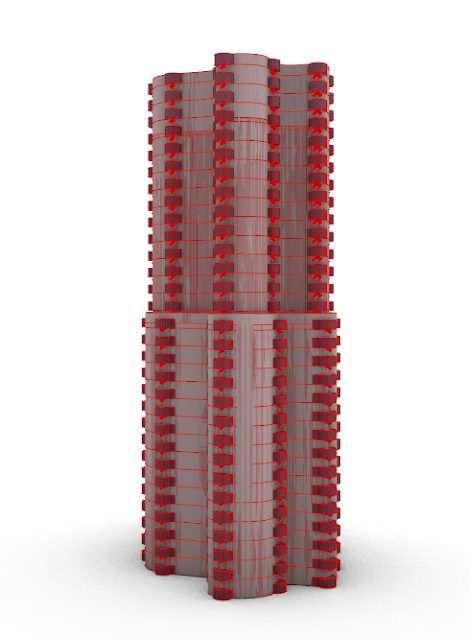
One other thing I wasn't able to do want get the entire structure to rotate. The base curve would rotate, but it wouldn't rotate around the center of the curve, and it did not move the whole structure. I think I understood the rotation for simple objects, but since this curve was more complex I couldn't get it to work properly.


Overall this was a great assignment because it was really fun to play with the new tools in Grasshopper and see how far I could take them.

Comments

Popular posts from this blog

Parametric Furniture: Renders

This week I finished creating my table. I switched from a coffee table to an end table, because I wanted the stem of the table to be longer, to better represent the shape of a plant. This table is a Voronoi patterned end table that is meant for a house plant to be a part of the furniture. The concept came from the question: how can plants become more integrated into our indoor environments? Plants, at least in my house, just sit on top of shelves and tables, this way the plant is fully a part of the furniture, and the growth of the plant determines the final design of the table. The name of this table is Nature Integrated Table.  The Voronoi pattern is inspired by the shapes of plant cells, and the overall shape of the table is inspired by a blooming plant. If this table was full size my hope is that the plant would be put in the dirt directly in the centre of the table, without a pot. This way the roots and the plant would start to grow through the Voronoi. The pattern also has na...

Sandcastle

 For the first assignment of OBDF 210, I created a sandcastle. I used tools such as Loft, ExtrudeCrv, Mirror, and Rotate to create the castle. It was a great continuation of last semester since I finished last year making a castle as well. To finish the assignment I used some different materials in the renders to show a more realistic sandcastle. Here are a few different renders of the sandcastle: This is the view mode I built the castle in, shaded. This is the colour rendered version of my sandcastle and the sandbox it is in. I also added a shovel. The following two photos are in the same render mode from other angles. This is the artistic render mode, which I have never used before, but really like. Finally, this is the ghosted render mode which helps show the castle from a straight-on view without only seeing the walls. This assignment was a great reintroduction to Rhino. I initially had a hard time remembering all the features within different commands, but once I got past that...

Recorder - Reverse Engineering Process 2

 This week I was able to finish most of my recorder. I solved all of my problems from last week, finished the bottom part of the recorder, and have most of the top done. I just have to finish the very top of my recorder where the reed fits into it. I am not sure why but the surface seems to be breaking up every time I split it. Other than that very top area I am happy with the way everything looks so far. Here are the 2D halves of the bottom and top that I then revolved: Here is the top in 3D, followed by the very top piece, you can see the surface break in the top left: Here is the bottom in 3D: Here is the reed, finally finished, after all of the last week's issues: Here are all the pieces put together, and compared to the real recorder: I just have to add the cutout close to the top, then it will be a perfect match. I'm looking forward to rendering the recorder and making it that translucent blue.